Hypnagogia
Hypnagogia: A Pre-Registered Test for Offline Memory Replay in a Whole-Brain Drosophila Connectome Model
Aniketh Bandlamudi · University of Virginia · November 2026
- Abstract
-
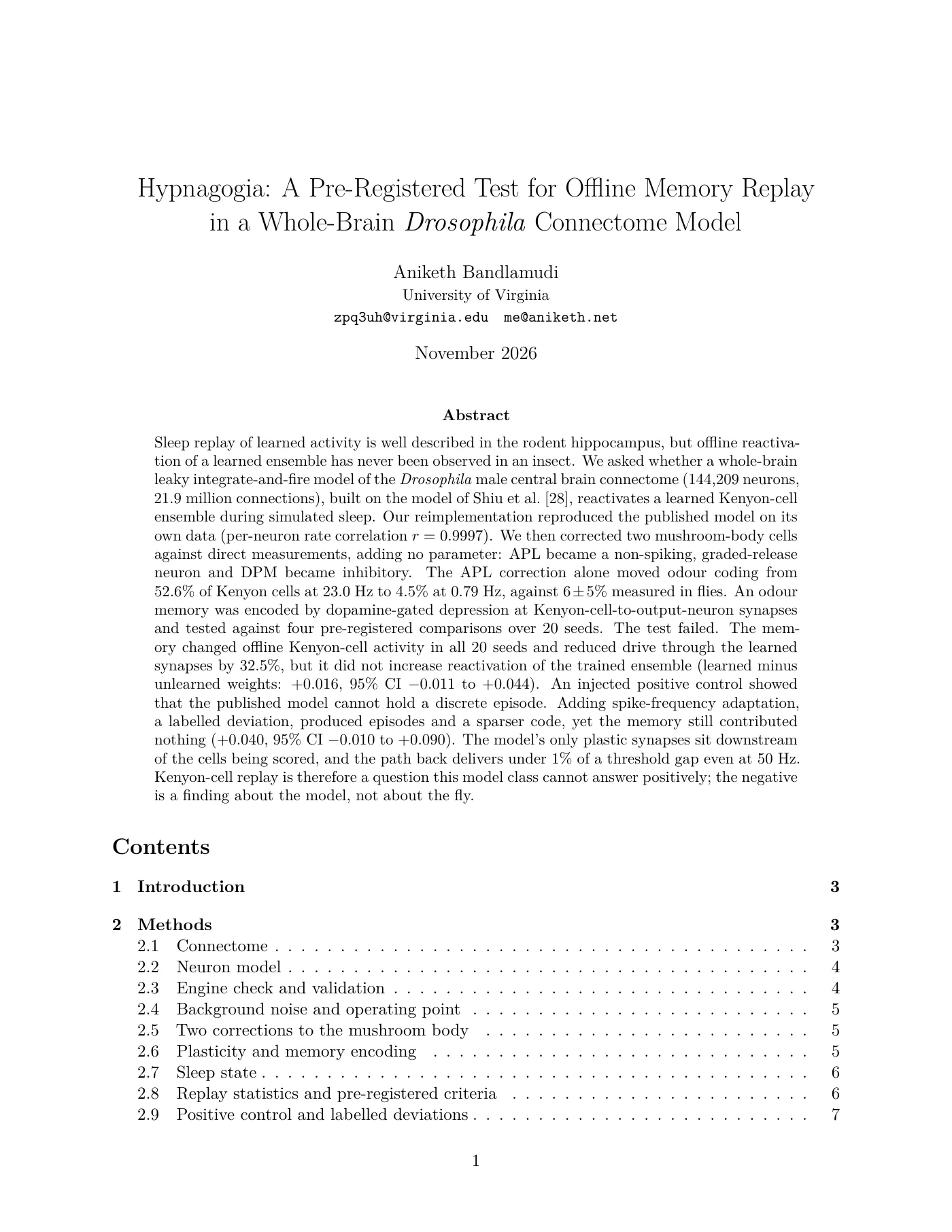
In the rat hippocampus, ensembles that fire together during waking fire together again in later sleep, but offline reactivation of a learned ensemble has never been observed in an insect. This paper asks whether a whole-brain leaky integrate-and-fire model of the Drosophila male central brain connectome, 144,209 neurons and 21.9 million connections, built on the model of Shiu et al. (2024), reactivates a learned Kenyon-cell ensemble during simulated sleep.
The reimplementation reproduces the published model on its own data. Two mushroom-body cells are then corrected against direct measurements, adding no parameter: APL becomes a non-spiking, graded-release neuron and DPM becomes inhibitory. An odour memory is encoded by dopamine-gated depression at Kenyon-cell-to-output-neuron synapses and tested against four pre-registered comparisons over 20 seeds.
The test fails. The memory changes offline Kenyon-cell activity in every seed and cuts drive through the learned synapses by a third, but it does not make the trained ensemble reactivate more. A positive control shows that the published model cannot hold a discrete episode; adding spike-frequency adaptation produces episodes, and the memory still contributes nothing. The model’s only plastic synapses sit downstream of the cells being scored, so the negative is a finding about the model, not about the fly.
- Results
-
- Engine check. The Brian2 reimplementation matches the published model’s own output on FlyWire v630, with per-neuron rate correlations of 0.9997 and 0.9999.
- The APL correction. Modelling APL as non-spiking, as it was measured to be, takes odour coding from 52.6% of Kenyon cells at 23.0 Hz to 4.5% at 0.79 Hz, against about 6% measured in flies, with nothing else changed.
- No replay. Only one of the four pre-registered comparisons passes, and the identical sleep run with unlearned weights gives the same reactivation (+0.016, 95% CI −0.011 to +0.044).
- A tonic memory trace. Offline drive through the learned synapses falls by 32.5%, a 26-fold amplification of a 1.23% weight change, expressed continuously rather than in episodes.
- Why. The only path from the memory back to the Kenyon cells delivers under 1% of a threshold gap even at 50 Hz, and the corrected APL holds its source neuron far below threshold.
- With episodes. Adding adaptation, a labelled deviation, gives the model episodes and a realistic sparse code, but in 13 of 20 seeds the ensemble stays on for the whole run, and the memory still contributes nothing (+0.040, 95% CI −0.010 to +0.090).
- Paper
-
 Read all 18 pages
- Cite
-
@misc{bandlamudi2026hypnagogia,
  author = {Aniketh Bandlamudi},
  title = {Hypnagogia: A Pre-Registered Test for Offline Memory Replay in a Whole-Brain {Drosophila} Connectome Model},
  year = {2026},
  month = nov,
  howpublished = {\url{https://aniketh.net/research/hypnagogia/}},
  note = {Preprint}
}